
Limit what distracts you.
Local app rules and domain filters limit selected content, including known adult and gambling domains. The local VPN service does not send your traffic to a ZUHD VPN server.
Explore protectionA feed, a video, another glance at your phone. ZUHD helps you decide in advance what you want to make room for right now, and what can wait.
Instead of making the same decision with every impulse, choose rules for your apps and websites. A focus session or schedule can activate those rules for the time you choose.
The impulse
You reach for an app you selected for your focus session.
Your earlier choice
ZUHD checks on your device whether that app is currently blocked.
The boundary
The block screen shows the reason and the time remaining.
Illustrated flow with protection active and Android permissions set up. Not measured data or a promised personal outcome.
You choose your boundaries. ZUHD brings protection, planning, and progress together.
Local app rules and domain filters limit selected content, including known adult and gambling domains. The local VPN service does not send your traffic to a ZUHD VPN server.
Explore protectionStart a focus session, choose a profile, or plan recurring time windows. You choose the duration and rules in advance.
Focus and schedulesFocus time and Side Quests contribute to your path. Levels, badges, and attributes show progress without treating a difficult day as a personal failure.
Explore your path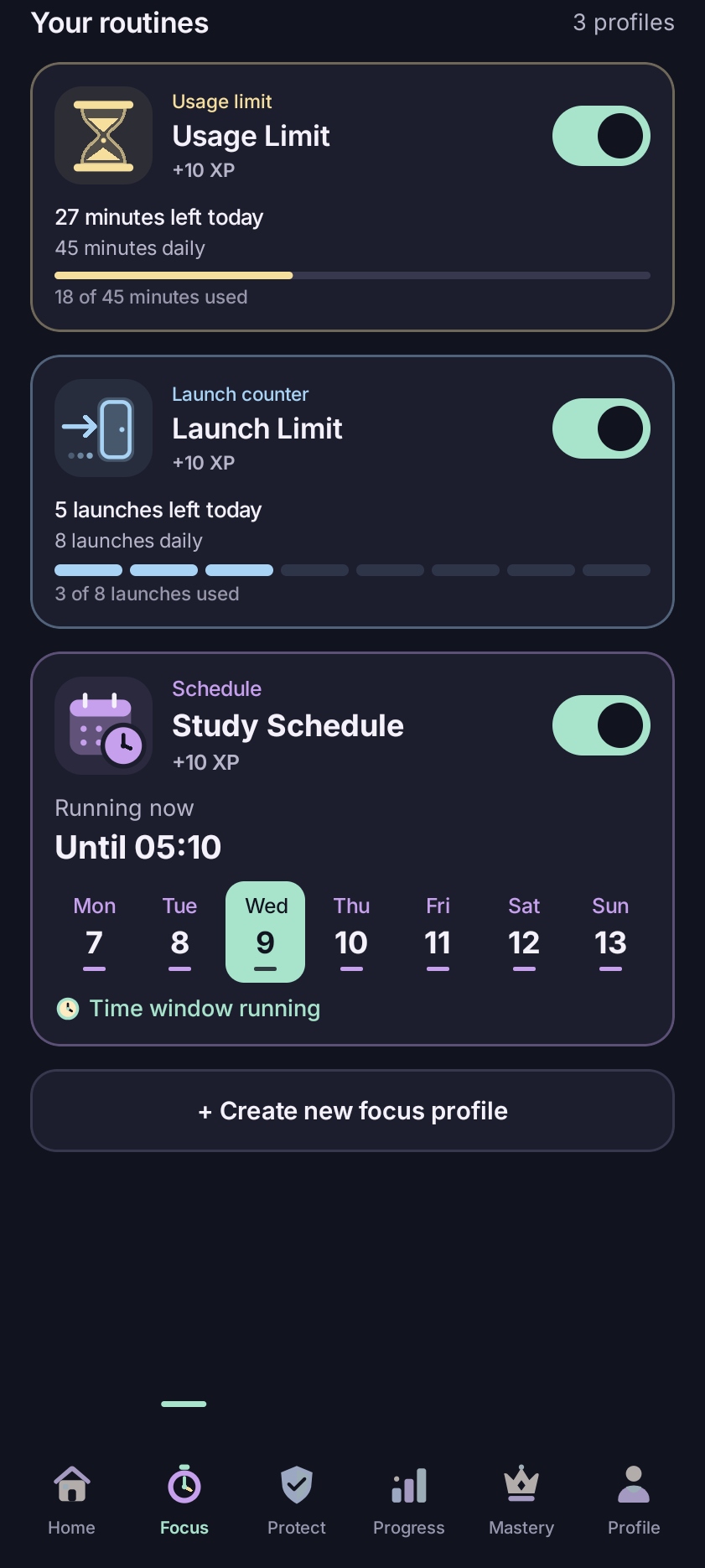
Research on screen time, interruptions, and the reward system can help explain usage patterns. It does not establish ZUHD’s effectiveness or diagnose any individual.
All sources and their context2008
Interrupted tasks weren't completed more slowly in the experiment – participants actually worked faster, but reported more stress, frustration, and time pressure.
Controlled lab study with artificial interruptions. Everyday life with smartphone notifications may behave differently from this study design.
2018
In a large US sample (over 40,000 children and adolescents), more screen time – beyond roughly one hour a day – tended to be associated with lower psychological well-being.
Observational study based on survey data. It shows an association, not a cause; effect sizes and how well it generalizes to adults are debated.
2014
In 64 adult men, more frequent pornography consumption was associated with a smaller volume in the striatum (part of the reward system) and weaker connectivity to the prefrontal cortex.
Cross-sectional study with a small sample: it shows an association, not that consumption causes these differences. Cause and effect remain unresolved.
2014
People with compulsive sexual behaviour showed stronger activation in reward regions (including the ventral striatum) in response to sexual cues than people without such behaviour.
Cross-sectional group comparison with a small sample: it shows differences in response, not that consumption causes them.
ZUHD is a tool for your choices. Android settings, granted permissions, and supported apps affect protection; no block is impossible to bypass.